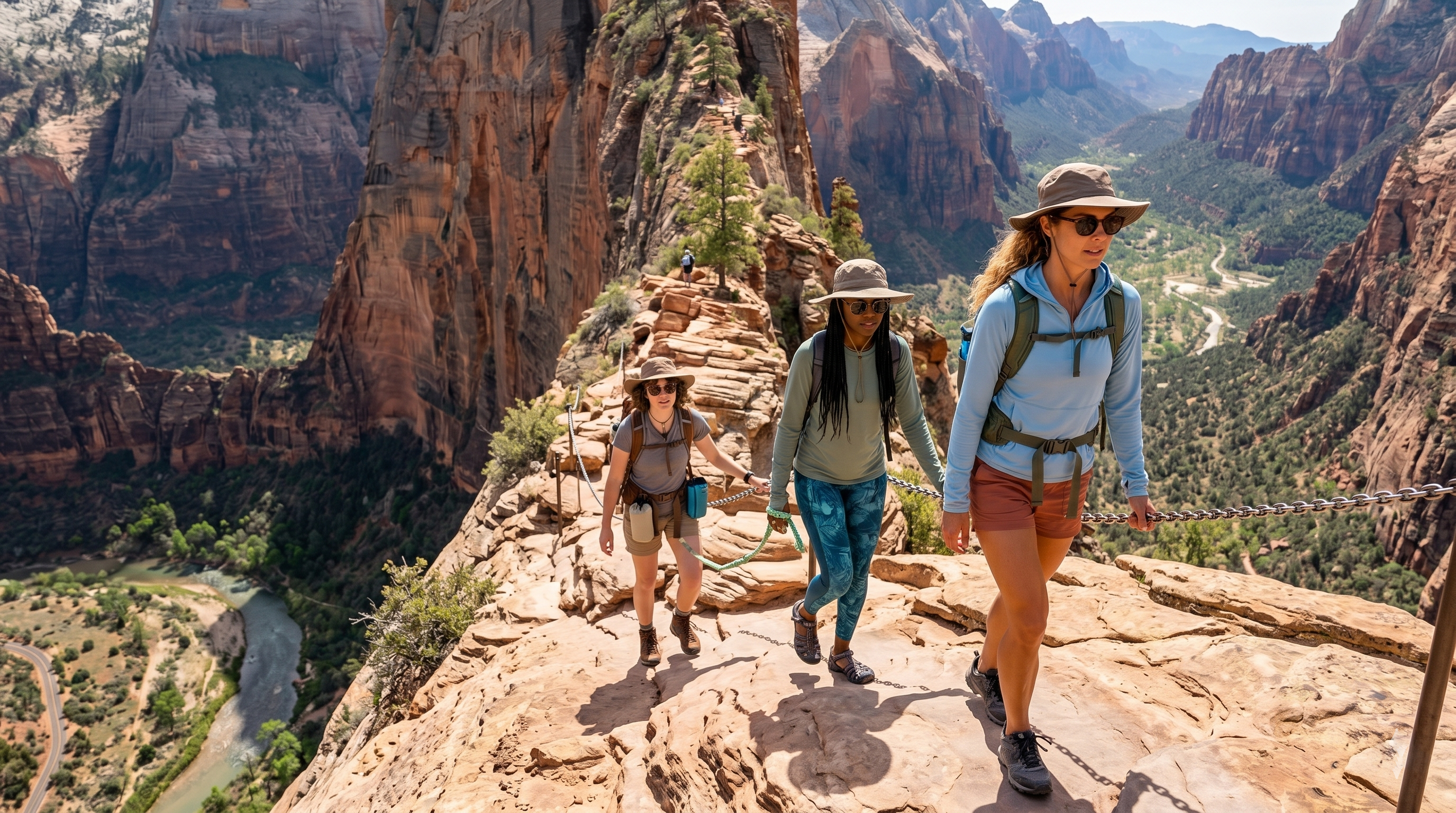
NO DOGS — Angels Landing, Zion National Park, Utah
Score: 100/100 — Great Day to Go
50°F. Feels like 43°F. Wind at 6mph with gusts to 6 — essentially still. AQI is 33, Good. Zero fires within 50km. Nearest fire is 186km out, low risk.
The score is 100 and the conditions are as clean as Zion gets before the summer heat and afternoon thunderstorm season arrives. Kipper is staying home — Angels Landing doesn't permit dogs. This is one of the rare trails I write about where the dog-friendly flag isn't part of the conversation, because the conversation is entirely about the light.
---
The Case for Going Today Specifically
Angels Landing is one of the most photographed hikes in the American Southwest. The views from the summit — the Virgin River zigzagging through the canyon floor 1,488 feet below, the sandstone monoliths on both sides, the depth of Zion Canyon spreading south — are legitimately world-class and look the same in photographs as they do in person, which isn't always true.
The challenge with Angels Landing photography, specifically, is light. The canyon is narrow. The walls are high. Direct sun hits the summit for a shorter window than you'd expect, and the canyon floor is in shadow for most of the day except around midday. In summer, midday at the summit is 100°F and the canyon air is haze-heavy. The photographs from summer at Angels Landing have a flatness to them — overexposed sky, flat canyon floor, no atmospheric depth.
In April, with AQI at 33 and temperatures in the 50s, the light behaves differently. Early morning sun hits the east-facing walls with angle and warmth. The canyon floor visibility is clean through the full depth of the frame. Golden hour from the summit in April is the kind of thing that makes you want to stay past the time you planned to leave.
The photography case for going today: air quality 33, clear visibility, spring light angle, no haze. This is the window.
---
What the Hike Is
5.4 miles out and back. 1,488 feet of gain. Rated hard. The route climbs from Zion Canyon floor up the West Rim Trail, reaching Walter's Wiggles — a series of 21 steep switchbacks that gain 400 feet in a short section — before reaching Scout Lookout. From Scout Lookout, the chains section begins.
The chains section requires a separate permit obtained through Recreation.gov. Without the permit, Scout Lookout is your turnaround point. Scout Lookout itself is an excellent viewpoint — the route to it is a legitimate hike — but the chains section to the actual summit adds 500 additional feet of gain over half a mile on exposed sandstone with substantial drop exposure on both sides.
The chains are fixed to the rock face and are the handhold system that allows hikers without technical climbing equipment to complete the final section. In good conditions (dry rock, no ice, no high winds), most fit adults can complete the chains section with confidence. Today's conditions — 50°F, 6mph wind, dry — are ideal for the chains.
If you're booking a permit for today: Check Recreation.gov for same-day or next-day availability. The Angels Landing permit system has daily slot releases and cancellations. April has more availability than summer but permits still require advance booking.
---
Conditions in Detail
At 50°F with a 43°F feels-like, you're comfortable moving uphill and you'll need a layer at the summit when you stop. The chains section involves both moving actively (hands-on-rock climbing) and standing still at exposed viewpoints, and the temperature differential when you stop is real.
Dress in layers with a wind layer accessible in your pack. At the summit, 50°F with 6mph wind and no insulation layer feels colder than it sounds.
Rain percentage: 0%. No precipitation risk today. Wet sandstone on the chains section changes the risk profile significantly — the chains become much more critical when the rock face is wet. Today is a dry-rock day, which is the correct condition for anyone doing this for the first time.
AQI at 33: This is exceptional for Zion in spring. April can bring dust events from the surrounding desert and fire-season smoke from Nevada and California. 33 means neither of those is happening today. The view from the summit will have depth in a way it doesn't always have.
---
Logistics
Getting to the trailhead: Angels Landing is accessed from the Grotto Trailhead in Zion Canyon, which is a Zion Canyon Shuttle stop. Personal vehicles are not permitted on Zion Canyon Scenic Drive during peak season — the shuttle is how you get there. The shuttle runs from the Visitor Center. In late April, check the Zion NPS website for current shuttle operating hours, which expand from shoulder season to full season during this month.
Zion NP entrance fee: The park requires an entrance fee or America the Beautiful pass. This is separate from the Angels Landing permit.
Chains permit: Separate from park entrance. Recreation.gov, search Angels Landing Permit. The fee is nominal. Without it, you can hike to Scout Lookout — which is genuinely impressive and doesn't require the permit.
Trail congestion: April weekends are busy. Weekdays in April are significantly quieter. If the score holds like this through the week, a mid-week visit will have the chains section with far fewer people than a Saturday.
---
Photography Specifics
For anyone going specifically for photography — which is the reason I'm going today:
Best light time: Early morning, before 10am. The east walls of Zion catch low morning sun that creates the warm tones and shadow contrast that make the canyon shots work. The summit gets direct morning sun. By midday the canyon floor is in harsh overhead light.
What to compose from the summit:
- Looking south down Zion Canyon: the full canyon depth, the Virgin River, the narrow canyon walls converging. Best in morning light with AQI-clean visibility.
- Looking north toward Angels Landing's own profile against the Zion walls: requires positioning off the main summit area, but the silhouette composition is strong.
- The chains section itself as foreground with canyon behind: dramatic perspective, especially if you can get a shot with other hikers on the chains for scale reference.
Lens: Wide angle (16-24mm equivalent) for canyon depth. The subject is scale — you need a wide FOV to communicate how far down the canyon floor is. Standard and tele lenses flatten the perspective in a way that undersells what you're seeing.
AQI consideration: At 33, you won't get haze softening your background. That's a feature, not a bug — the Sierra Nevada-visible clarity that low AQI provides in the Southwest means you can see detail in the canyon walls from the summit that summer photos don't show.
---
Olivia's Take
100/100 in late April at Angels Landing with AQI 33 and no wind is not a day I'm letting pass. This is the window. The chains are dry. The light is right. The permit is available if you move on it today.
I don't over-romanticize the hike itself — Walter's Wiggles are relentless, the chains section requires honest physical effort, and the summit is more exposed than photos suggest. But the view from the top of Angels Landing on a clear April morning, before the summer crowds and before the heat arrives, is the thing.
Kipper will be annoyed, as she always is when she gets left home on my best shooting days. That's the deal.
---
_Conditions current as of 2026-04-21. Check the live score at alwayshave.fun/trail/angels-landing-zion-ut before heading out. Chains section permit required — book at Recreation.gov. No dogs permitted anywhere in the Angels Landing permit zone._
📍 Live conditions for Angels Landing →